

The Hidden Risk in Your Clients’ Passive Portfolios: Why Index Concentration Matters Now
When most investors think about passive index funds, they picture safety, diversification, and low costs. But what if we told you that today’s most popular passive strategies are more concentrated than at any point in the last 50 years?
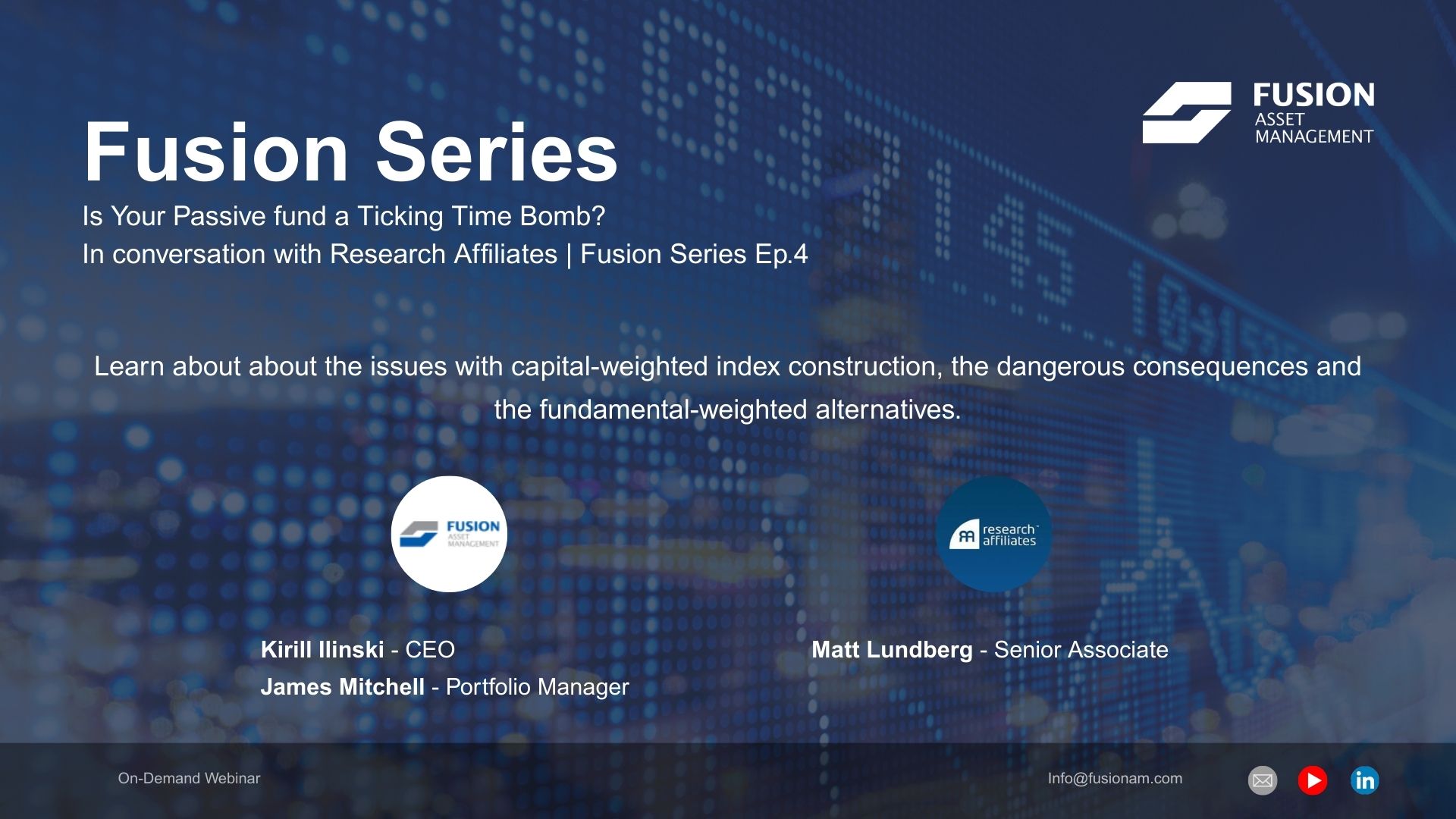
In our latest Fusion Education Series webinar, we sat down with Matt Lundberg from Research Affiliates to explore a critical blind spot in traditional market-cap-weighted indexing. What we discovered should concern every adviser managing client portfolios in today’s environment.
The Uncomfortable Truth About Passive Investing
Here’s the uncomfortable reality: traditional cap-weighted indices systematically force you to overweight the most overvalued companies whilst underweighting the most undervalued ones.
This isn’t a design flaw. It’s baked into the methodology. Because price directly determines weighting in cap-weighted indices, these strategies inevitably chase expensive stocks and sell cheap ones. You’re essentially buying high and selling low on autopilot.
Matt Lundberg highlighted a striking example. The Magnificent Seven tech giants now command a combined market cap of over £17.5 trillion. That’s more than all the companies in Europe combined. More than China. More than Japan twice over.
Does this reflect genuine economic value, or have we witnessed a dangerous concentration of capital driven by momentum and popularity?
Concentration at Historic Extremes
The numbers tell a sobering story. The top five stocks in the S&P 500 now represent over 25% of the index. The top seven account for more than 30%. This concentration level hasn’t been seen since the 1970s, when names like IBM, Exxon, and Kodak dominated in a similar fashion.
In 2024 alone, Nvidia contributed 22% of the S&P 500’s return. Add the other six Magnificent Seven names, and you’re looking at over 50% of the index’s performance driven by just seven companies.
When clients think they’re buying diversification across 500 companies, they’re actually making a massive concentrated bet on a handful of tech stocks trading at eye-watering valuations.
The Performance Drag Nobody Talks About
This concentration creates a hidden performance drag that becomes painfully obvious when markets correct. We’ve seen this film before.
During the tech bubble crash of the early 2000s, the average stock in major indices significantly outperformed the indices themselves. Over just two years, there was a 50% differential between the average company’s performance and the index return. Why? Because the index was overweight expensive tech stocks that crashed the hardest.
The same pattern emerged during the Chinese regulatory crackdown. Overweight the popular, overvalued names, and you amplify your downside when reality sets in.
Matt shared research showing this isn’t a new phenomenon. Look at the top 10 largest companies by market cap at the start of each decade since 1980. The list changes dramatically. The dominant names of one era become the has-beens of the next.
Lucent Technologies was among the top 10 largest companies globally in 2000. By 2006, it had been acquired. That’s how quickly fortunes can reverse, even for companies that seemed invincible.
The DeepSeek Wake-Up Call
January 2025 delivered a stark reminder of this vulnerability. When DeepSeek emerged, Nvidia’s supposed impenetrable moat suddenly looked far more questionable. Markets that assumed these companies would dominate indefinitely were forced to reconsider.
History suggests that disruptors get disrupted. The companies driving today’s market may not be tomorrow’s winners. Yet cap-weighted indexing keeps doubling down on today’s expensive favourites.
A Different Approach: Fundamental Indexing
This is where fundamental indexing offers a compelling alternative. Instead of weighting companies by their market cap (which is just price times shares), fundamental indexing weights companies by their economic footprint.
Research Affiliates pioneered this approach by combining sales, cash flow, dividends, and book value to determine company weights. The methodology creates a stable anchor that trades against shifting market expectations rather than chasing them.
You still get exposure to the Magnificent Seven and other leading companies. The difference is that you hold them in proportion to their fundamental economic size, not their popularity with momentum traders.
The Japan Lesson
One of the most powerful illustrations of this approach comes from examining regional allocations over time. In the late 1980s, Japanese companies dominated global indices, eventually accounting for nearly 50% of market-cap-weighted global portfolios.
That concentration proved disastrous. Japan’s weight crashed back to around 10% as the bubble deflated, destroying enormous wealth for investors who followed cap-weighted strategies.
A fundamentally weighted approach would have gradually increased Japan’s exposure as Japanese companies grew in economic importance. But it never would have allowed that extreme 50% concentration driven purely by price momentum.
Fast forward to today, and we’re seeing the same pattern with US exposure. The US now represents roughly 72-73% of the MSCI World Index. That’s an enormous regional bet for what’s supposed to be a globally diversified portfolio.
Smoother Journey, Better Outcomes
Beyond avoiding concentration blowups, fundamental indexing delivers a smoother investor experience. Sector and regional allocations shift gradually in line with genuine economic changes rather than lurching wildly with market sentiment.
You can see this clearly in the technology sector. In cap-weighted indices, tech allocation spiked dramatically during the dotcom bubble before crashing. Today, it’s squeezing out other sectors again as the Magnificent Seven dominate.
With fundamental weighting, tech allocation increases steadily as the sector’s genuine economic importance grows, but without the violent swings that devastate client portfolios and test their resolve to stay invested.
The Contrarian Alpha
James Mitchell, our Portfolio Manager, raised an important point during the webinar. Fundamental indexing is inherently a contrarian strategy. It rebalances quarterly, systematically selling what’s become expensive and buying what’s cheap.
This means you should expect periods of underperformance during bull markets driven by narrow leadership. When a handful of stocks are rocketing higher, fundamental strategies will trail because they’re not chasing the momentum.
However, the long-term data is compelling. Over full market cycles, fundamentally weighted indices have delivered approximately 1.5-2% per annum of outperformance versus their cap-weighted equivalents.
This excess return comes from two sources. First, you avoid the worst of the downside when overvalued names revert to fair value. Second, you capture the upside as undervalued companies you’ve been accumulating finally get recognised by the market.
Efficiency and Cost
Some advisers might assume fundamental indexing is expensive to implement. After all, you’re rebalancing quarterly and actively tilting away from cap weights.
The reality is quite different. Because fundamental indices use five-year averages of their weighting metrics, changes happen gradually. There are no sharp movements requiring heavy trading. Turnover remains low, keeping transaction costs manageable.
Research Affiliates also uses a staggered quarterly rebalance, splitting the portfolio into four tranches and rebalancing one tranch each quarter. This approach captures rebalancing alpha whilst maintaining efficiency.
Current Market Context
Why does all this matter particularly now? Because we’re entering a period where passive strategies may face their biggest test in years.
As James demonstrated in the webinar using JP Morgan’s Guide to the Markets data, starting valuations are highly predictive of future returns. When the S&P 500 has traded at current forward P/E levels (around 22.8 times), subsequent five-year annualised returns have never been positive.
Never.
If you’re following traditional cap-weighted indexing for equity allocations, you’re allocating roughly three-quarters of your clients’ equity exposure to US stocks at valuations that have historically led to poor five-year returns. That’s not diversification. That’s a very specific bet that this time is different.
How We’re Positioning Client Portfolios
At Fusion, we’ve begun rotating client portfolios away from standard market-cap-weighted indices towards fundamental strategies. This isn’t about market timing. It’s about profit-taking after a strong bull market run and repositioning to achieve more balanced, risk-adjusted returns.
In our Optima portfolios constructed with ETFs, we’re using the Invesco FTSE RAFI US 1000 ETF for US equity exposure and the Invesco FTSE RAFI Emerging Markets ETF for emerging-market exposure.
For our Active portfolios using mutual funds, we’ve allocated to the UBS FTSE RAFI Developed 1000 Fund for global equity exposure.
These positions provide exposure to market leaders such as Nvidia and the Magnificent Seven. The crucial difference is we’re holding them at weightings aligned with their fundamental economic value, not their price momentum.
The Bottom Line for Advisers
Passive investing isn’t as passive as it seems. Cap-weighted indices make active bets every day, systematically overweighting expensive stocks and underweighting cheap ones.
In benign bull markets where momentum persists, this works brilliantly. But when markets correct, concentration bites hard. And the correction typically happens faster than the run-up, catching investors by surprise.
Fundamental indexing offers a middle ground. You maintain broad market exposure and keep costs reasonable. But you trade against the market’s excesses rather than amplifying them.
For UK advisers navigating today’s concentrated, expensive markets, that’s worth serious consideration.
Want to dive deeper into fundamental indexing and how Research Affiliates’ strategies work? Watch the full webinar on our YouTube channel where Matt Lundberg and our investment team explore these concepts in detail, with real data and specific portfolio implementation insights.
Questions about implementing fundamental strategies in your client portfolios? Our investment team is here to help. Contact us to discuss how these approaches might fit your practice.
Contact our investment team here
For more updates and future episode announcements, follow us on LinkedIn